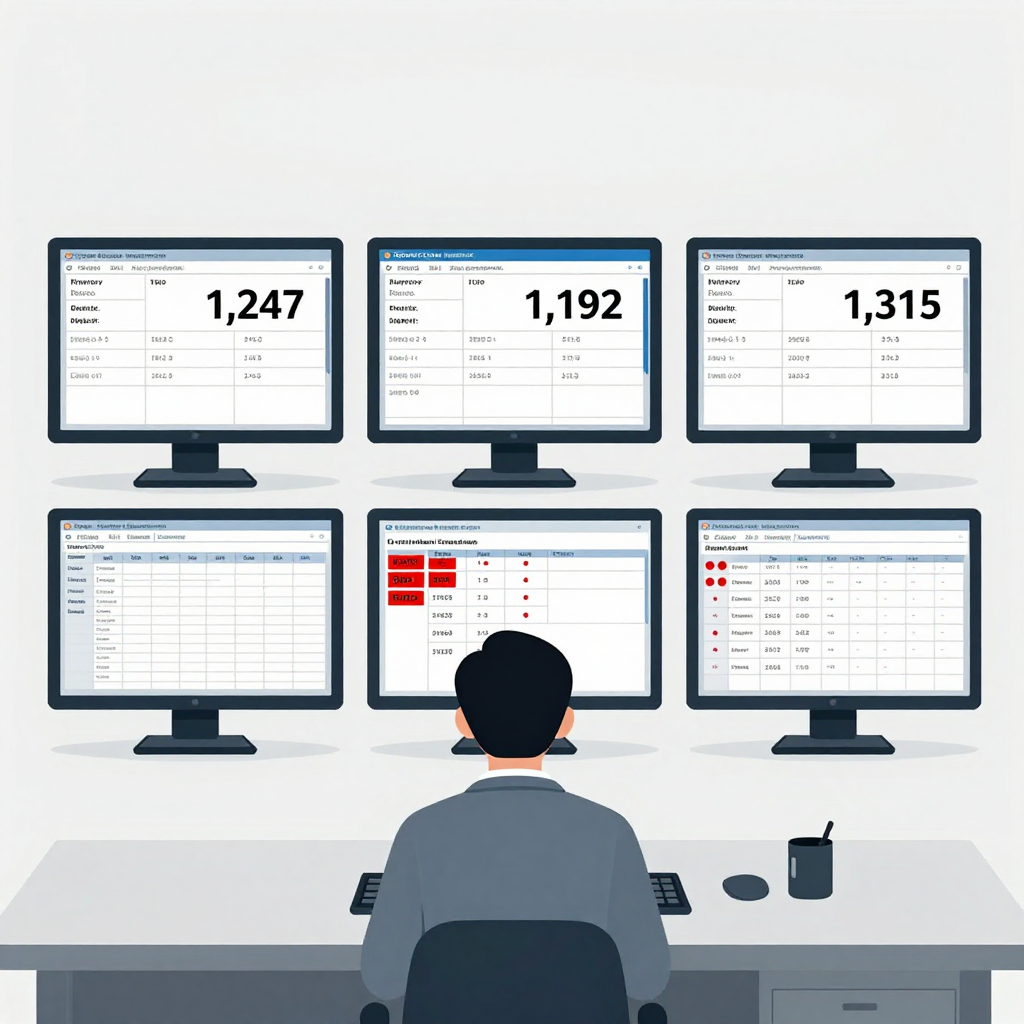
ERP Silos Are Choking Your AI Ambitions
A Fortune 500 manufacturer recently discovered that 37% of its AI model predictions failed not due to poor data quality, but because the data lived in three separate ERP instances—each with its own schema, update cadence, and governance rules. The result? A 22% drop in forecast accuracy for supply chain disruptions, enough to stall a quarter’s production roadmap.
This isn’t an edge case. According to SAP partners surveyed by ARNnet, 62% of enterprises report that their AI initiatives stall not for lack of models or compute, but because the underlying ERP and transactional systems can’t feed clean, real-time data into those models. The problem compounds when workflows span HCM, SCM, and CRM—each with its own integration layer, API limits, and latency.
The Hidden Cost of Fragmented Enterprise Intelligence
Fragmentation isn’t just an efficiency tax—it’s a compounding liability. A logistics operator we worked with found that manual reconciliation between its ERP and TMS added 4.2 hours per shipment for high-value orders. At scale, that’s 1,200 hours annually per logistics coordinator, or roughly $180,000 in labor costs per employee. Multiply that across a 500-person supply chain team, and the annual burn approaches $9M—before accounting for delayed shipments or stockouts.
The opportunity cost is steeper. IBM’s partnership with OpenAI to bolster enterprise AI underscores how firms with unified data fabrics can deploy models 3x faster than those relying on point-to-point integrations. For a retailer with $2B in annual revenue, that could mean $60M in margin gains from reduced inventory write-offs and dynamic pricing adjustments—if the data flows seamlessly.
Bear Systems’ AI Fabric: Plug-and-Play ERP Integration
Our AI Fabric architecture replaces brittle ETL pipelines with a graph-based data mesh that unifies ERP, HCM, SCM, and CRM into a single semantic layer. Unlike traditional middleware, it doesn’t just move data—it enforces schema consistency, handles real-time updates, and embeds AI models directly into workflows. For example, our HCM connector auto-syncs payroll data from Workday into our AI-driven headcount planning model, eliminating the 2-3 day lag that derails workforce forecasts.
Key capabilities include: (1) **Unified API Gateway**—a single endpoint for all ERP transactions, reducing integration time from weeks to days; (2) **Adaptive Data Governance**—automated lineage tracking and role-based access controls that meet SOC 2 and GDPR requirements without manual oversight; (3) **Embedded AI Agents**—pre-built agents for demand forecasting, fraud detection, and dynamic discounting that run natively in SAP, Oracle, or Microsoft Dynamics. These aren’t bolt-ons; they’re part of the ERP’s transactional fabric.
ROI That Scales With Your AI Roadmap
Consider a mid-market manufacturer with $500M in revenue. After deploying our AI Fabric, it reduced supply chain forecasting errors by 18%, cutting excess inventory by $8M annually. The payback period? 14 months. For a larger enterprise with $5B in revenue, the same architecture enabled a 12% reduction in working capital tied up in receivables—freeing up $240M for strategic investments.
The strategic value isn’t just financial. Firms using unified data fabrics can deploy new AI models 60% faster than competitors, according to IBM’s enterprise AI push. That’s the difference between reacting to market shifts and anticipating them. For a financial services firm, that could mean the difference between missing a credit risk spike and adjusting portfolios preemptively.
What Unified Enterprise Intelligence Actually Looks Like
In practice, this means a CFO’s dashboard updates in real time as procurement orders are approved, not 24 hours later. It means a supply chain planner receives an alert when a supplier’s risk score spikes—before the disruption hits production. It means HR’s attrition model pulls from actual payroll data, not stale spreadsheets. The end state isn’t just fewer errors; it’s a system where every function operates on the same version of truth, and AI models are no longer afterthoughts but core drivers of decision velocity.
Take the example of a global retailer we worked with. Before AI Fabric, its ‘single view of customer’ was a myth—data lived in 11 systems. After deployment, the same view is generated in under 5 seconds, enabling dynamic pricing and personalized promotions that lifted same-store sales by 7%. The kicker? The entire integration took 9 weeks, not 9 months.
The Tradeoff: Control vs. Speed in AI Deployment
Some enterprises resist unified architectures, fearing vendor lock-in or over-engineering. The reality? The cost of *not* unifying is higher. A 2026 Federal Reserve study on supply-side risks found that firms with fragmented data ecosystems were 2.3x more likely to misprice inventory during volatility spikes. The tradeoff isn’t between control and speed—it’s between short-term flexibility and long-term resilience.
The alternative—piecemeal AI deployments—creates technical debt that compounds with every new model. IBM’s OpenAI partnership highlights how enterprises are now prioritizing architectures that scale AI without reinventing the wheel for each use case. The question isn’t whether to unify, but how soon you can afford not to.
Audit Your Workflows—Before AI Does It for You
If your ERP still treats AI as a ‘bolt-on’ rather than a core capability, it’s time to stress-test your data fabric. Start with a 30-day audit: map every workflow that touches ERP data, from order-to-cash to hire-to-retire. Flag the ones where manual reconciliation or batch processing introduces latency. Then ask: *Could an AI agent make this decision in real time?* If the answer is no, your architecture is already obsolete.
We’ll run this audit for you—no strings attached. Bring your current ERP roadmap, and we’ll show you where your AI investments are leaking value. Schedule a session [here], and we’ll deliver a gap analysis within 10 business days. The alternative? Watching your competitors deploy AI agents while your data sits in silos.
Sources
Source: RealTimeNews — AI Fabric – Connecting Every Business Function Through Seaml
SAP partners cite AI integration challenges as the primary bottleneck
IBM’s OpenAI partnership signals enterprise AI’s shift to unified architectures
Supply-side risks amplify the cost of fragmented data ecosystems