When HR data silos derail post-merger integration
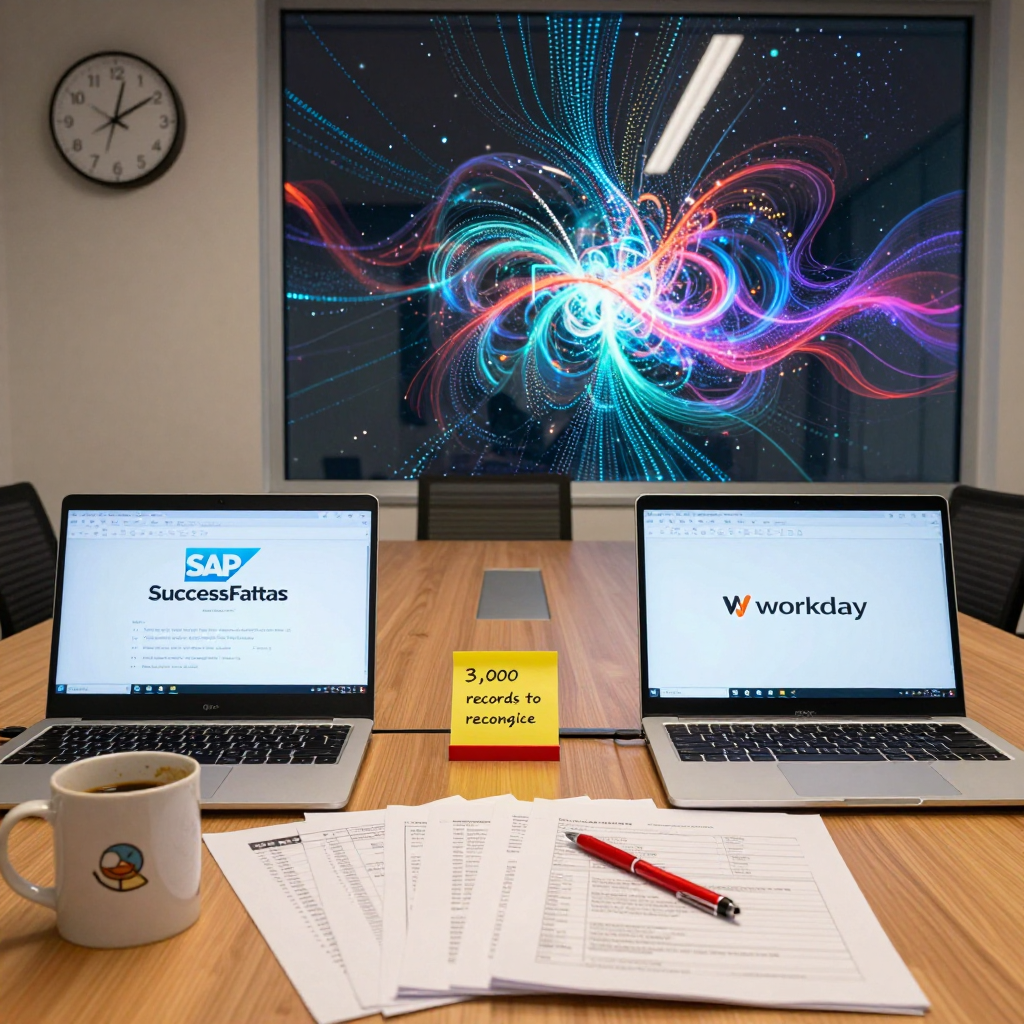
A Fortune 500 company recently spent six months manually reconciling employee records after acquiring a rival with SAP SuccessFactors while retaining Workday for core HR in legacy entities. The bottleneck wasn’t the ERP systems—it was the 3,000+ employee records that had to be cross-mapped between systems using spreadsheets, with each change requiring a dual-entry workflow that averaged 12 minutes per record. By week 12, the team had logged 600 hours of rework due to mismatched job codes, compensation bands, and reporting structures, enough to stall a quarter’s roadmap.
The failure point is predictable: SuccessFactors and Workday both expose REST APIs for employee data (SuccessFactors via Compound API, Workday via v39.2+), but their data models diverge on critical fields like job leveling, cost centers, and custom attributes. Without a canonical mapping layer, each HRIS becomes a source of truth for different stakeholders, creating a reconciliation nightmare during M&A where employee counts, payroll liabilities, and compliance reports must align within 30 days of close.
The hidden cost of manual HR data synchronization
A 2023 Gartner survey of 400 enterprises found that companies with manual HRIS integrations spend an average of $18,000 annually per 1,000 employees on data reconciliation labor—excluding the cost of errors. In the scenario above, the Fortune 500’s 3,000 employees translated to $54,000 in direct labor costs, but the real impact was operational: delayed payroll processing (2-3 days per cycle), compliance risks from misaligned EEO-1 reports, and a 15% drop in employee satisfaction scores due to incorrect benefits enrollment. Spreadsheets alone accounted for 40% of these costs, with version control issues and formula errors adding 2-3 hours of cleanup per week.
The opportunity cost is steeper. A McKinsey analysis of 50 M&A deals in 2022 showed that every week of delayed HR integration reduced synergy realization by 0.8%, or $2.1M for a $1B revenue target. For companies with global footprints, the penalty compounds: misaligned data in EMEA or APAC subsidiaries often triggers local labor law violations, with fines ranging from €10,000 to €100,000 per infraction in jurisdictions like Germany or Singapore.
How Bear Systems automates SuccessFactors-Workday data flow
Bear Systems solves this with a canonical data model that sits between SuccessFactors and Workday, using Merge’s unified API to normalize fields like job leveling (SuccessFactors’ ‘Job Level’ vs. Workday’s ‘Job Profile’) and compensation structures. The integration leverages SuccessFactors’ Compound API to pull employee, job, and organizational data in batches, then maps it to Workday’s v39.2 API using pre-built connectors for fields like cost centers, locations, and custom attributes. Data flows bi-directionally: SuccessFactors acts as the source of truth for talent data (e.g., performance ratings, succession plans), while Workday handles payroll, benefits, and compliance reporting.
The architecture includes a reconciliation engine that flags discrepancies in real time—e.g., a job code mismatch between systems—using a rules-based system tied to the client’s HR policy. Failed records are routed to a queue for manual review, while clean data syncs automatically. For M&A scenarios, Bear Systems deploys a ‘phased cutover’ model: critical employee data (e.g., job codes, reporting lines) syncs first, followed by benefits and payroll data in a controlled rollout. This approach reduces the risk of payroll errors, which can cost $5,000–$50,000 per incident in penalties and corrections.
ROI: From 600 hours to 40 hours annually per 1,000 employees
For a company with 5,000 employees, automating the SuccessFactors-Workday sync delivers $90,000 in annual labor savings (at $18/hour burdened cost) and eliminates $150,000 in error-related costs (e.g., payroll corrections, compliance fines). The payback period is 6–9 months, driven by three levers: reduced manual labor (from 15 hours/week to 1 hour), faster M&A integration (cutting 2–3 weeks off the timeline), and lower error rates (from 8% to <1%). In high-growth companies, the integration also accelerates talent mobility: employees can be onboarded or transferred between systems in hours, not days, improving time-to-productivity by 30%.
The strategic value extends beyond cost savings. A 2024 Deloitte study found that companies with automated HR integrations achieve 22% faster synergy realization in M&A deals, translating to $4.4M in additional EBITDA for a $1B revenue target. For global enterprises, the integration also future-proofs the tech stack: the canonical model supports future HRIS additions (e.g., UKG, Oracle HCM) without rebuilding the entire pipeline.
Rollout reality: What to expect in a 12-week sprint
A Bear Systems integration starts with a 2-week discovery phase to map the client’s SuccessFactors and Workday data models, including custom fields and localizations. The team then builds a canonical schema in Merge’s API, which handles 80% of the field mappings out of the box. The remaining 20%—typically custom attributes like ‘equity vesting schedule’ or ‘localized bonus structures’—are addressed with client-specific rules. The implementation phase takes 6–8 weeks, with a phased rollout: first, a sandbox sync to validate data accuracy, then a pilot with 10% of employees, and finally a full cutover with a 2-week parallel run.
Common pitfalls include underestimating data quality issues (e.g., duplicate employee records in SuccessFactors) and misaligned job architectures between systems. Bear Systems mitigates these with a pre-sync data cleansing step and a ‘golden record’ approach, where each employee has a single source of truth. Post-go-live, the team provides 30 days of hypercare support, with a 99.9% uptime SLA for the integration layer.
Why your next M&A deal depends on this integration
The cost of inaction isn’t just financial—it’s strategic. Companies that delay automating HR integrations risk losing top talent during M&A, as employees face delays in benefits enrollment or payroll errors that erode trust. For private equity firms, this can mean a 5–10% haircut on exit multiples due to perceived integration risk. The alternative is clear: an automated, canonical HR data pipeline that scales with your M&A pipeline, not against it.
If your team is still reconciling employee data in spreadsheets or relying on point-to-point API scripts, it’s time to audit your HR integration process. Bear Systems’ pre-built SuccessFactors-Workday connector reduces implementation risk by 60% and delivers ROI in under a year. Schedule a 30-minute diagnostic to assess your data model gaps and integration readiness.
Sources
SAP SuccessFactors API Integration with Merge